
Dubbed the “AI apocalypse”, in the space of 1 week, 10’s of thousands of previously safe data coding jobs were lost at leading IT developers. These “jobs of the future” that our young have been pushed towards for the past decade have now been replaced by computers programming computers. AI is exponentially more disruptive than the machines of the industrial revolution (number of people affected and speed) or the advent of computers and internet. So what will be the impact on humans and what we do?
There has been a feeling that tech-leading companies would be the last impacted by AI, after all they are on the forefront of AI development and perceived as immune compared to other sectors. Turns out they were first. In one week, starting with Wisetech (2,000 people, 30% of its workforce), Amazon (16,000 workers), Morgan Stanley (2,500 people), Block (Square and Afterpay, 4,000 – half its staff), Atlassian (1,600 people after financial losses continue to grow in a company that hasn’t made money in over 20 years), Commonwealth Bank (second round, 300 people), and Telstra (650) are just the beginning. Salesforce cut 4,000 late last year. Several employers have gone on a hiring freeze, openly questioning whether entry-level talent should even be hired in the first place in an AI-dominating world.
Experts’ comments include:
- “Optimists hail this as good news, given people won’t have to work. I simply cannot imagine that will be good for society”. – Howard Marks, Billionaire investor of Oaktree Capital. “AI is no longer a co-pilot needing step-by-step instructions” – it now does the whole job start to finish. The philosophical debate over whether AI is “truly thinking” is irrelevant: “If I can produce the analytical output of a $200,000-a-year research associate, it doesn’t matter to the person paying the bill” just that ”the work product is reliable enough to be useful, and increasingly it is.”
- “AI now has the capability to draft about 95% of prospectuses in just a few minutes, compared to human teams taking weeks” – David Solomon, CEO Goldman Sachs.
Recruiters say that businesses are demanding adaptable AI-fluent employees on the one hand, but on the other it takes years to find and retrain employees, meaning AI is moving many times faster than society’s ability to adjust. The predictions that within 5 years half of all white collar jobs will be replaced seems conservative.
But exactly what is an AI-fluent person? A large part of society has totally lost its ability to think, readily accepting whatever AI serves up. I’m only half AI-savvy, and have found that about half the time AI gives an answer “near enough” – but still wrong. For instance, had someone a week ago tell me that 35% of CO2 was manmade, check AI. So I asked AI, which said that 35-50% of the earths CO2 was manmade – but read past the headline and it based the figure on adding all the CO2 since the industrial revolution together and that only naturally produced CO2 gets absorbed – a clearly absurd assumption and therefore misleading and wrong conclusion. Did the same search today, and it has amended the search to a more correct statement that only 3-4% of CO2 is manmade. Being AI-fluent should mean identifying the BS, something that will only get harder as AI “adapts” as well as controls access to the historical information we can find.
But I digress. AI has benefits, but as they say: “be careful what you wish for”. So what happens to all those people displaced by AI? Maybe some can be retrained to other occupations. Optimists claim it will mean people won’t have to work for a living and we’ll have a Universal Basic Income (UBI). Not sure that their utopia will turn out the way they might imagine. Golf courses and waterways would be very crowded, but just who would pay for it all? Our Government relies on individual income tax for 51.6% of its revenue and companies for a further 24.2%. What then happens when the pool of employed tax paying people declines at the same time that big overseas AI companies (that pay no tax in Australia) take over? At best, the Universal Basic Income (UBI) is most likely going to be the same as the income that the poorest person you know currently has, and declining from there… There’s an old saying that JOB stands for Just Over Broke. Maybe UBI stands for Under Broke Idealist? And the obvious flow on of people not having any money to spend is that remaining businesses will have no customers, quickly accelerating the spiral.
Unions and Government are busy creating “make believe” jobs – jobs that are legislated and create some activity to make people feel important and like they are doing a job, but actually adding very little benefit. Australian Government even goes so far as to make it very difficult for existing companies to improve efficiencies, especially using AI – a unique position globally and will likely mean Australian companies can’t succeed in a global economy if all the benefits simply flow offshore to places that are free to adapt. What this legislative approach misses is that same straight jacket doesn’t apply to new entrants, so eventually the existing companies will go broke. Smaller companies are probably more “job safe” than larger ones that can automate more standardised processes.
Machines from the industrial revolution didn’t take over all jobs, just like computers didn’t end paperwork either. Duties done by lawyers, doctors and accountants are having the “research/procedural” aspects replaced, whilst the “empathy” and explaining portion will be much harder to replace by a machine. Coffee machines haven’t killed off people wanting a coffee made by a person just like online shopping hasn’t totally removed the fact that people buy from people they trust (i.e. salespeople and baristas still exist). But supply and demand will mean that more people doing less overall tasks in a particular profession will over time decrease what they can charge (= declining income levels).
Whilst not a guarantee, the AI “proof” careers are likely to be those with a human element to it as well as hands on (often blue collar) jobs. These jobs are often unfashionable areas like having to serve other people (tourism/hospitality), caring for people, psychiatrists and the like. We have a chronic shortage of infrastructure of all types, so hands on building skills, mechanics, electricians and the like should also have a good future. Paradoxically, many basic and mundane jobs (like lawn mowing, cleaning and picking up rubbish and the like) may also have a longer expiry date but currently have few takers. (refer to graph supporting this theory)
The irony in all this might very well be that the world’s oldest profession (prostitution) may very well also be the last profession. Guess that means we’ll all be F*&^ed!
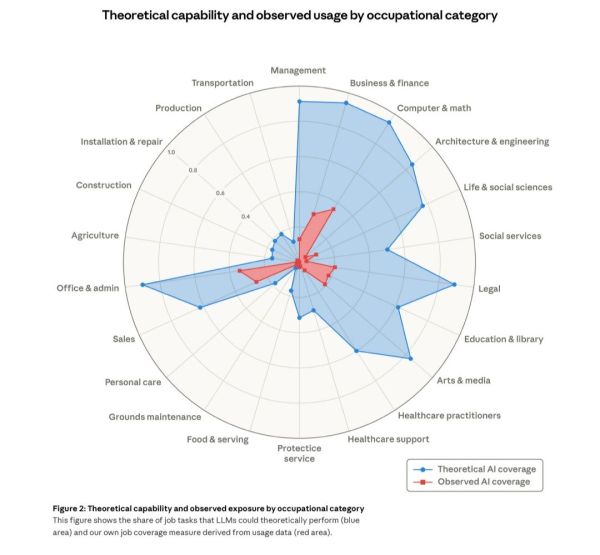
See original image at www.anthropic.com/research/labor-market-impacts
Words from the wise
“New beginnings are often disguised as painful endings” – Lao Tzu.
“Victory comes from finding opportunities in problems.” – Sun Tzu.
As always, Onwards and Upwards!
Fred Carlsson
General Manager