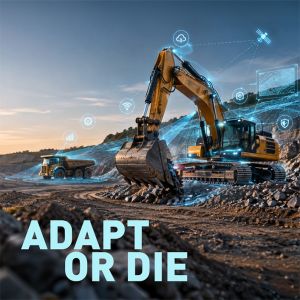
Sometimes the solutions to problems have been staring us in the face for a very long time before we accept and implement them. Usually, it comes down to either not knowing some options are possible (like the below building and Earth Moving examples), or in many cases wilfully keeping blinkers on. This is the sad story of a Queensland company that has a solution to many of our country’s power issues, especially remote locations like mines or Islands, and fits in the back of a ute or 20 foot container at the point of usage. The worst part is that they had to go to the USA to get off the ground.
Like big Legos?
We have clever builders in Australia. But it’s a bit embarrassing that it now takes 32 months to build the average house when it took 12 months a little over a decade ago and I recall 6 months was the standard contract 25 years ago. The increase is due to 3 levels of Government adding a total of 40-50% of the construction cost in various charges and compliance costs. But the construction industry isn’t squeaky clean in this either, with plenty of additional costs and charges sneaking in over the years. Which is why we need to look at how to do things differently, especially now that new taxes have made it unviable for many people to invest money in housing.
One of these creeping cost escalations is the cost of employing people as well as the add-ons. Especially when we can’t get enough people to do the work, new solutions get looked at which work around the worst pinch points. It should come as no surprise then that there is a growing industry related to modular housing. This is nothing new, there have been basic “dongers” used on construction sites as offices and toilets for decades, and mine sites and even the Wellcamp Covid site was a “city” built in a short time frame using 265 transportable modular houses.
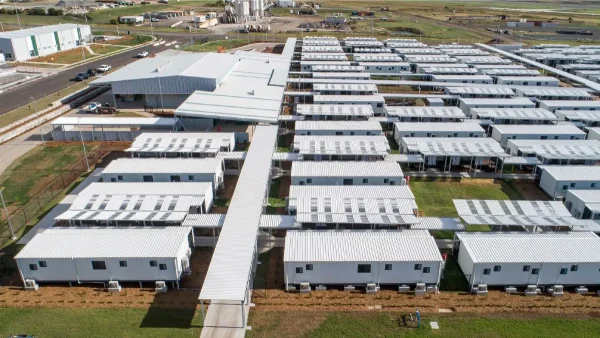
Wellcamp Quarantine Facility
These were usually built in Australia, but are now increasingly being imported from Vietnam, China and other locations. They have also progressed from being basic short life “rubbish”, through small “granny flats” to now complete houses. Would be great if these factories were in Australia. It’ll mean less people in construction and more working in factories, but one positive is it might help free up construction workers for other construction and infrastructure work.
In a cost of living and housing crisis, this trend can’t be ignored. Modular homes cost about $2,000-$4,500/m2, whilst traditional site builds are $3,000-$5,400/m2.
But the real saving will likely come when Governments are forced to accept “standardised approvals”. Already now project builders have a portfolio of “standard designs” that meet building codes. The time has come where if a building design meets the building codes and zoning requirements, it should mean automatic approval. So not only can modules reduce the construction costs by roughly 25-30%, the Government attributed portion should be able to be cut by at least low double digit percentages – with more predictable approval processes without the whims of the individuals. We just need forward thinking Governments.
Small flexibility
Other ways for earth moving companies to improve the bottom line is to use the most effective solutions for each job. For example, was talking to a builder who was doing a medium sized commercial development. They were using an excavator/articulated dump truck combination to dig out inside a building construction. By swapping out the articulated truck for a Morooka tracked dumper, they found efficiencies on the job. It’s not new technology but was new to them. In this case the lower loading height improved safety, the rubber tracks spread the ground pressure more evenly and worked better in the softer site sections, the tight turning capabilities greatly reduces cycle times in snug spaces, and the 360-degree slewing function opens up endless load dumping opportunities. It’s horses for courses, with an articulated truck having a larger (volume and weight) carrying capacity making it more efficient on sites with more open spaces, and on larger jobs in particular a lower cost per cube.
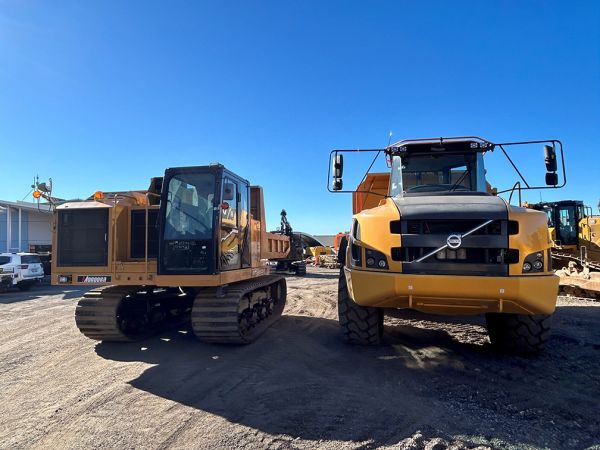
Moorooka Tracked Dumper vs Volvo articulated Dump Truck
The power of modules
One could argue that the biggest issue facing our nation is our power grid. Despite increasing investment in the grid by 110% over the past 15 years, capacity has increased just 10% (i.e. spent more than the original grid to achieve only a 10% increase in available power). Energy hungry AI data centres and EV’s will exponentially increase the demand, so with less and less suitable land for renewables, a priority has to be 24/7 reliable supply close to the point of usage (i.e. minimal grid upgrades and especially transmission lines).
Enter Brisbane’s Bobby Gallagher and his Unity Nuclear Battery. Using technology that has been producing power commercially now for 72 years (in 1954 the first nuclear reactor went online in Soviet Unions Obninsk, followed by UK in 1956 and USA in 1957), the reactor section fits in the back of a Ford F150, and adding the generator section means each 1MW (24/7 reliable and stable supply) would fit in a 20 foot container. It overcomes the dependence of water cooling because it is air cooled and can be installed underground at the point of usage. Being modular, it can be transported and upscaled from 1 to 1,000MW if required.
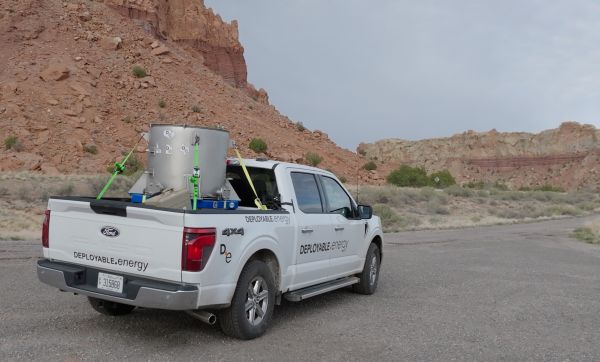
Source – Employable Energy.
Our Government is telling AI datacentres that they are welcome in Australia so long as they BYO power. Overseas, they are building complete nuclear power plants – here they are insisting on only renewables, which begs the question: where can they build these data centres that require 10-500MW+ of constant power 24/7/365? One Unity shipping container sized unit would require 5 hectares (50,000m2) of solar panels or 10 hectares (100,000m2) of wind turbines. That assumes the renewables run at maximum capacity constantly, which they never do for more than short burst, so it requires areas 2-3 times bigger again, PLUS transmission lines, battery storage, and a 100% backup (gas/diesel or similar) to ensure the power stays on all the time. So ONE typical AI datacentre would require approximately 500,000,000m2 of land (that’s 500km long by 1km wide) covered in renewables… Where will they all fit?
The micro-reactor can run for 5 years before requiring a teaspoon or so of uranium for refuelling. The life span of each unit will outlive the renewables having to be replaced 4 times in the same time. It is already approved for use by various US regulators with first deliveries due in 2028. Initial production is booked out to 2035 at a value of $100 billion. The estimated cost of the first units will be electricity at 15c per kilowatt (remember, minimal grid connection required on top of this, which is more than half the cost on our power bills), dropping to 5 cents per kilowatt by the mid-2030’s when production volumes increase.
Unbelievably, this game changing technology is banned in Australia because of dogmatic ideology and a subsidised industry that will squeal like pigs when the rug is pulled from under them. There are other SMR’s (small modular nuclear reactors) already being built (water cooled), so it really is criminal to continue to install unreliable power at massive cost into our grid when demand is set to explode. 19 out of the 20 most developed nations in the world use and are installing nuclear plants – Australia is the one nation that doesn’t.
It’s time we changed our thinking that big isn’t always better. Savvy investors have always understood that small ideas can become massive opportunities if they are scalable. It’s time that we accepted the same thinking when it comes to modularising things like buildings and power supply.
Words from the wise
“If you’re not part of the solution, then you are a part of the problem” – Eldridge Cleaver
“Progress is impossible without change, and those who cannot change their minds cannot change anything.” — George Bernard Shaw
“The significant problems we have cannot be solved at the same level of thinking we were at when we created them.” — Albert Einstein
Did you know? Recruitment Industry surveys have found that up to 50% of candidates reported within a 12 month period of having formally accepted a job offer and backing out before their start date. This is a disaster for employers who have to restart the whole process.
As always, Onwards and Upwards!
Fred Carlsson
General Manager